Connectivity

Industrial protocols & fieldbus

One device replaces a stack of gateways. Melanite drives EtherCAT servos and I/O on the real-time cycle, polls and writes Modbus TCP devices, and runs its own MQTT broker — so field devices, building gear and IoT sensors all land as live ports in the same control logic.

Status Core shipped

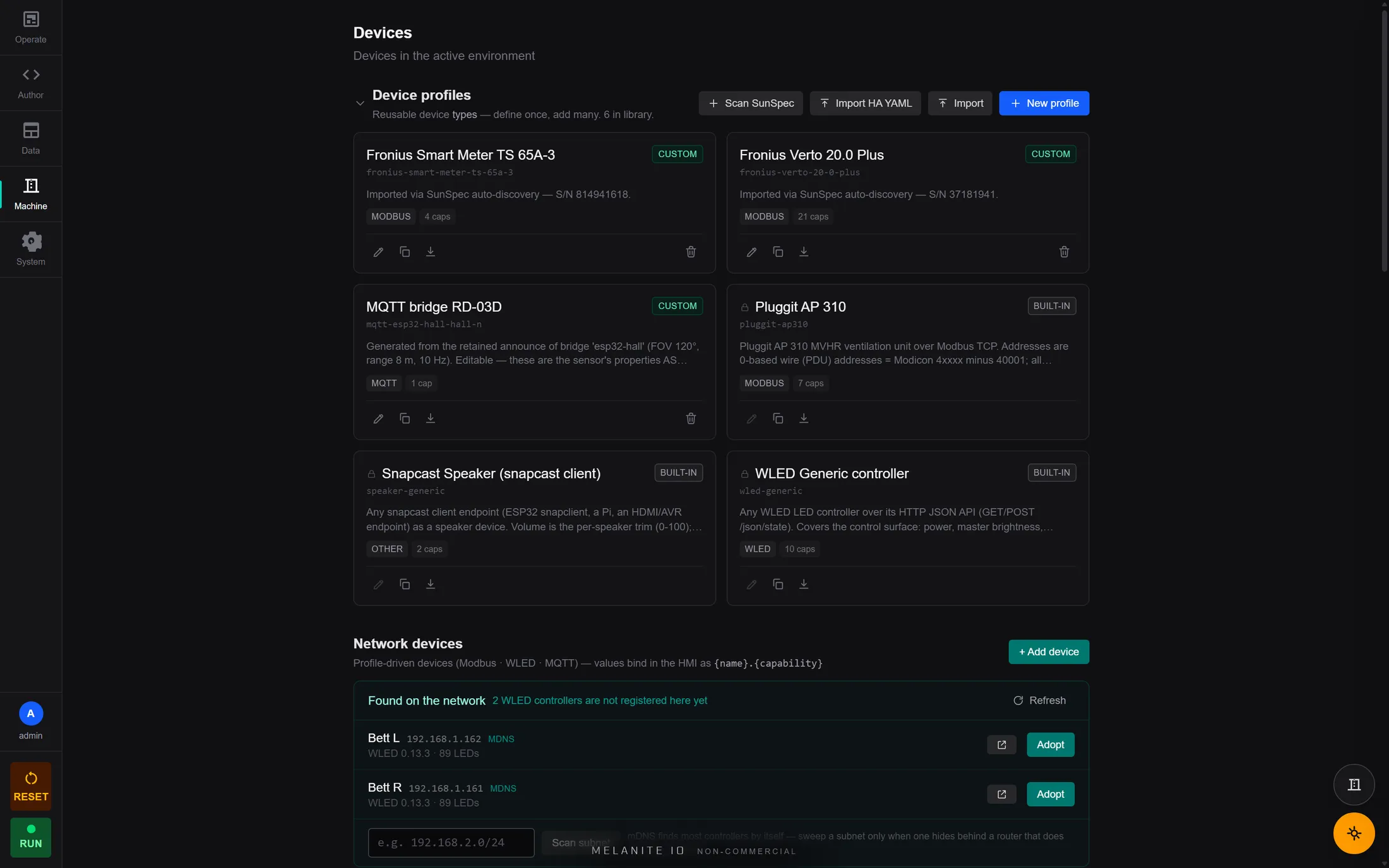
The Melanite device manager showing Modbus TCP inverters, an MQTT bridge and a WLED controller side by side in one list.
Modbus TCP, MQTT and WLED devices in one registry — the protocol is a property of the profile, not a separate subsystem.

In one line

Melanite connects to hardware over three verified protocols: EtherCAT (as master, on the real-time cycle, including CiA-402 servo drives), Modbus TCP (all four register tables, all four byte orders, 16- through 64-bit types and SunSpec scale factors — read and write), and MQTT (an embedded broker plus MQTT as a full device protocol, so a Shelly, Tasmota plug, Zigbee2MQTT sensor or custom ESP32 becomes an ordinary device with named values). Every value becomes a typed node port — no glue code, no external broker, no gateway. OPC UA, CANopen, EtherNet/IP and Modbus RTU are on the roadmap and are not claimed as shipped.

Capabilities

EtherCAT master

Real PDO I/O and CiA-402 servo drives on the real-time cycle, ESI XML parsing with scaling, units and enums, distributed-clock sync, plus SDO read/write while the bus is in operation — so a drive can be commissioned live without disturbing the cycle. Verified on real Beckhoff terminals and drives.

Modbus TCP

All four tables (holding and input registers, coils, discrete inputs), all four byte orders, bit-in-register extraction, U16 through F64, and SunSpec dynamic scale factors. Read and write verified against real hardware.

MQTT, as a protocol

An embedded broker with per-bridge credentials, one internal bus, and MQTT as a device binding — so an MQTT device gets named variables, HMI bindings, charts and logging like any other. Topic conventions match Home Assistant's, so existing configs translate.

Honest offline state

A device's online state is asserted from the broker, its last-will and staleness — and a value that fails to decode yields no reading at all, never a fabricated zero. A crashed sensor reads as absent, not as 0 °C.

Devices announce themselves

A bridge can announce its model, range and accuracy; it then appears as discovered, and adopting it generates a device profile. Discovery is never automatic registration — nothing joins your system because it shouted on the LAN.

Port mapping

Any protocol value becomes a typed node port, a bindable variable, a chart series and an HMI binding — in one step, with no glue code.

On the roadmap

OPC UA server and client, CANopen, EtherNet/IP, Modbus RTU over serial, and EtherCAT distributed-clock timestamped outputs. Designed, not shipped — we don't list them as features until they run.

Worked examples

Retrofit a Modbus device

Add closed-loop control to an existing ventilation unit or variable-frequency drive.

How

Map the device's registers into node ports through the device manager — by hand, by probing it live, or by importing an existing Home Assistant Modbus YAML — then feed a PID output straight to the reference register. No PLC and no gateway in between. Verified against a real Pluggit ventilation unit, fan speed stepping physically from the graph.

Why Melanite

Home Assistant has no industrial fieldbus. Node-RED can poll Modbus but is not an EtherCAT master and has no real-time guarantees. CODESYS is a genuine master but treats MQTT and consumer IoT as someone else's problem. Melanite is a real fieldbus master, a Modbus client and an MQTT broker in the same box that runs the logic — and it is honest about the protocols it hasn't built yet.

FAQ

Is Melanite an EtherCAT master or a slave?

Master. It drives EtherCAT I/O couplers and servo drives directly on the real-time cycle, so you do not need a separate master PLC. Hardware-verified on real Beckhoff terminals and a CiA-402 servo drive.

Which protocols are actually shipping today?

EtherCAT (master), Modbus TCP, and MQTT — all three verified on real hardware, plus WLED for addressable LED. OPC UA, CANopen, EtherNet/IP and Modbus RTU over serial are designed and on the roadmap, but not built. We list them as roadmap, never as features.

Can I talk to my existing PLC?

Over Modbus TCP or MQTT today. OPC UA — the usual answer for exposing a machine to SCADA or MES — is the next protocol on the roadmap and is not available yet.

Do I need an external MQTT broker?

No. The broker is embedded. External clients authenticate with per-bridge credentials because the broker is a write path into your system; the device's own client needs no configuration at all.

Free, full-featured

Every feature, free for personal use.

One binary runs every tier — the licence only toggles entitlements, never the feature set.